- The Sideline
- Posts
- World No. 1 Negotiates 3-Month Ban
World No. 1 Negotiates 3-Month Ban
Concerns in the tennis world arise over athlete discipline process 🎾

Sideline Sports Law
February 20, 2025
Professional tennis players are speaking out.
On Saturday, World No. 1 Janik Sinner reached a settlement with the World Anti-Doping Agency after a urine test last March revealed a prohibited substance in his body.
The 23-year-old from Italy has won three of the past five Grand Slam tournaments as a younger era of tennis stars are looking to follow in the footsteps of the sport’s legends, like Federer, Nadal, and Djokovic.
A few defined acronyms before we dive in:
WADA: World Anti-Doping Agency
CAS: Court of Arbitration for Sport
ITIA: International Tennis Integrity Agency
Let’s serve it up:
Anabolic Steroid Detected
A brief background leading up to the Sinner-WADA settlement:
In March of last year, two urine samples from Sinner contained Clostebol, an anabolic steroid prohibited by WADA. There was no appeal or pushback that a banned substance was in Sinner’s body.
Instead, after Sinner’s urine test results, the twofold question became: (i) how did the steroid enter Sinner’s system; and (ii) what should be his punishment?
Investigation + Applicable Legal Standard
If you ask Sinner, the banned substance came from his physiotherapist who provided Sinner massages and used an over-the-counter spray to treat a cut on his finger.
Scientific experts supported the argument that Clostebol entered Sinner’s body through the physiotherapist’s treatment — which included massages to Sinner’s body after the physiotherapist used the spray with Clostebol on his finger.
The ITIA agreed, stating the Italian tennis star “bears no fault or negligence” and chose not to suspend the 23-year-old.
From ITIA’s website: “Tennis you can trust.”
However, WADA appealed to CAS and argued that the ITIA applied the wrong legal standard. WADA argued Sinner should be suspended for one to two years because the appropriate legal standard — strict liability — does not account for whether or not Sinner acted reasonably.
Therefore, even if Sinner did not purposefully use the prohibited substance, he is still guilty and should be punished accordingly.
Settlement Reached
WADA then released a statement on Saturday, saying the organization “accepts that Mr. Sinner did not intend to cheat, and that his exposure to clostebol did not provide any performance-enhancing benefit.”
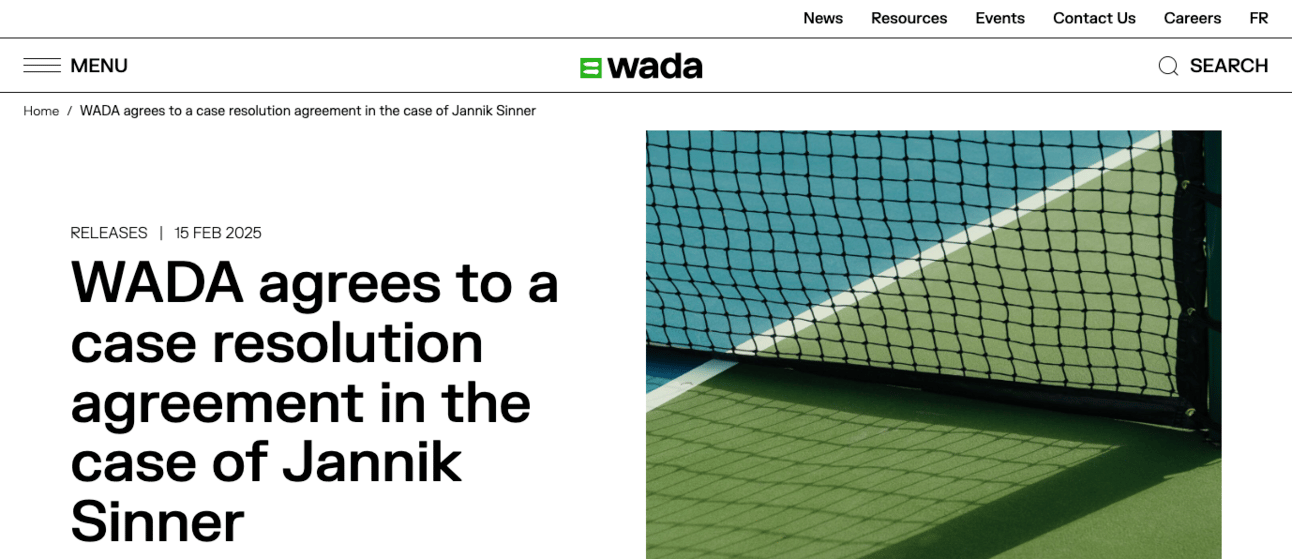
Full WADA statement on its website
WADA added that substance entered Sinner’s body through the “negligence [] of his entourage” but athletes bear responsibility for the actions of their entourage.
However, WADA concluded, “based on the unique set of facts” a three-month suspension was appropriate and the agency will withdraw its appeal to CAS.
Sinner’s three-month suspension will take place form February 9 to May 4.
The next Grand Slam tournament?
The French Open, which begins May 25. Sinner could even play in the Italian Open in Rome, his home country, which begins on May 7.
In the end, despite having a banned substance in his body, Sinner will not:
miss any Grand Slam tournaments
be stripped of his ATP Number 1 ranking
lose titles won with Clostebol in his system
Notably, Sinner won the U.S. Open in September after the Clostebol-positive test results were publicly revealed in August.

Sinner hoisting the U.S. Open trophy
Top Tennis Players Share (Not-So-Positive) Thoughts
As you could probably imagine, other tennis players weren’t so pleased with the three-month negotiated settlement.
Players primarily expressed concern over a lack of transparency and trust in WADA and other agencies and organizations involved.
A few reactions from the tennis world:
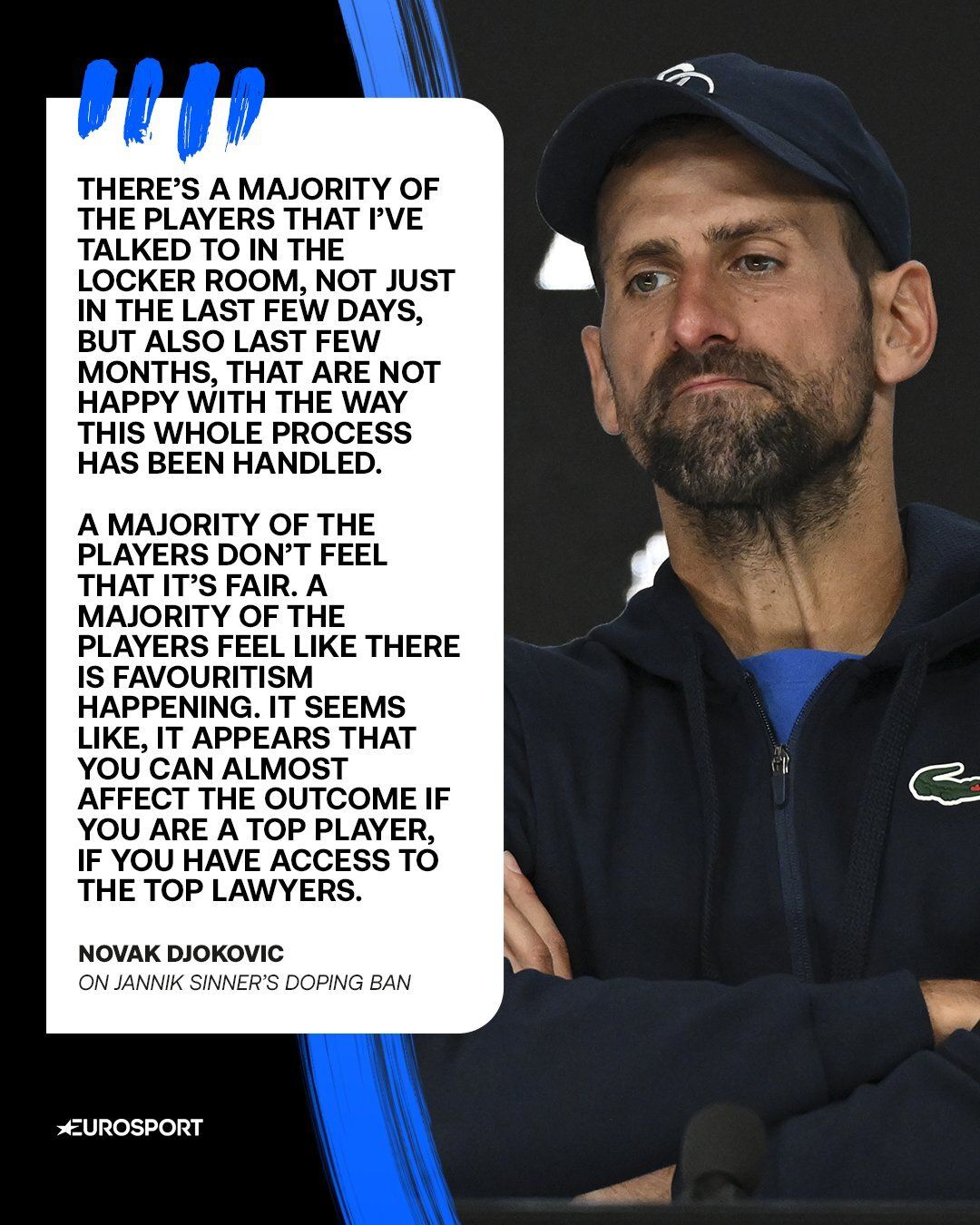
Novak Djokovic: a “majority of the players don’t feel it’s fair” and there is favoritism for athletes who have “access to the top lawyers.”
World No. 5 Jessica Pegula spoke out:
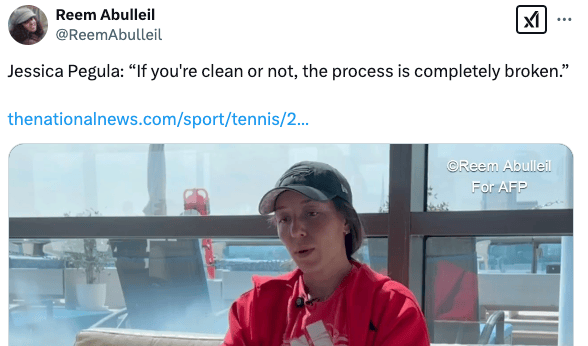
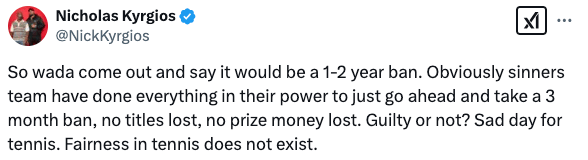
Nick Krygios: “Fairness in tennis does not exist” and why its a “sad day for tennis”:
Stan Wawrinka expressing concern on the integrity of the sport:

Looking Ahead + My Thoughts
When I first saw the headline I was genuinely perplexed.
How is a professional athlete being disciplined able to “negotiate", “accept” or “reach a settlement” regarding their own punishment?
In the NBA, NFL, NHL, and MLB, players often appeal punishment and discipline to the league.
For example, in 2023 Texans LB Denzel Perrmany had his three-game suspension reduced to two games for illegal hits.
Or in the case of Calvin Ridley, the NFL WR unsuccessfully appealed his one-season ban for betting on games, which was upheld for the 2022 season.
But actually going back and forth with a governing body or agency to negotiate one’s punishment? That seems rare — or completely unheard of — to me.
I can understand why other tennis players are frustrated. Lack of transparency in trust in decisions that affect the integrity of the game should not be taken lightly. There’s hardly been any media coverage over this and I’m assuming most people will forget about it in a few months.
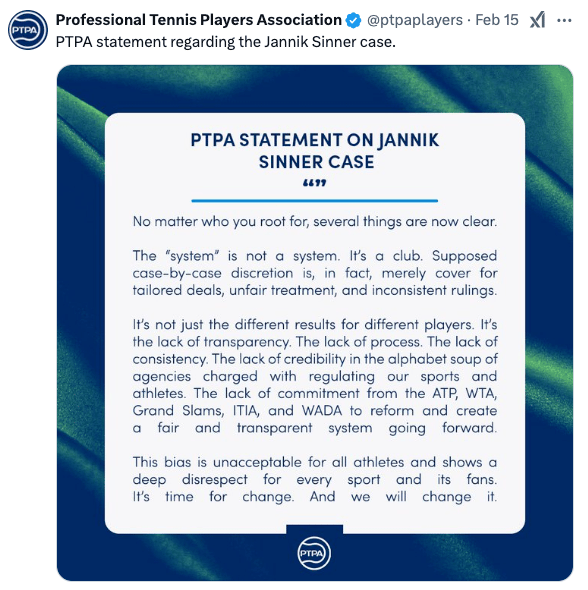
I’m curious what, if anything, the Professional Tennis Players Association will do on behalf of its players.
The PTPA, founded by Djokovic and Vasek Pospisil in 2019, expressed a need for change in an assertive statement:
Conversation Starters 🗣️
SGA Parts Way With Wasserman, Will Represent Himself 📝
Thunder All-Star Shai Gilgeous-Alexander parted ways with his agent, Thad Foucher of Wasserman, and will serve as his own agent according to NBA Insider Chris Haynes. The MVP frontrunner is leading the NBA with 32.5 ppg and is eligible to sign a four-year, supermax extension worth nearly $300M this offseason.
Appellate Court Restores Ex-White Sox Trainer’s Lawsuit ⚾️
Last Friday, an Illinois Appellate Court revived a sexual discrimination lawsuit that was dismissed in 2023. Plaintiff Brian Ball, the former White Sox head trainer, worked as a trainer with the team since 2000 and claims he was fired in 2020 because of his sexual orientation. The case returns to the trial court level and could settle at any time.
Lawsuit Alleges DraftKings Program “Preyed On” Users 🎰
A lawsuit filed in a New York federal court claims that DraftKings “invite-only VIP program” targets addicted gamblers, first reported by Wall Street Journal. Pennsylvania psychiatrist Dr. Kavita Fischer is suing the sports betting giant for negligence and intentional infliction of emotional distress, claiming the company recklessly induced her to continue gambling despite showing signs of addiction.
Four Nations Face-Off final tonight in my hometown. It’s been fascinating to witness how the NHL abandoned its All-Star game and is now slated to break viewership records.
The NBA could take notes — I wouldn't be surprised if we saw Team USA vs. World starting next year.
Happy almost Friday,
Duggs
Know someone who will enjoy this newsletter? Share it with them and have them sign up here: https://thesideline.beehiiv.com/subscribe
Sources:
The Sideline’s work, including this article, is for information purposes only and should not be construed as legal advice. This article does not create an attorney-client relationship. The opinions expressed in the article belong solely to the author and do not express the views or opinions of the author’s employer.